
Déjà vu: Do we learn empathy?
Or is it always there and some of us manage to unlearn it?

Empathy. Caring. Compassion. Understanding.
When I took German in high school, I learned there were two ways to know things: Ich kenne and Ich verstehe. One, the teacher said, meant to know with your head. The other was to know...she didn’t have the exact words in English...she thought it was more like to stand with someone. It was the first time I realized there was a difference between knowing and understanding.
I was going through some old files last week and came across a project I had forgotten about—Home Tales, according to the program—“A Unique Theatre Piece Exploring Issues of Home and Homelessness.” The first performance was in May, 1991. I was listed in the program as Judith McDaniel: Poet/Screenwriter. The Director and the innovator of this project, Paula Sepinuck, said that for her Home Tales began from a desire “to understand and explore the many meanings of home and homelessness.”
There it was again. To understand.
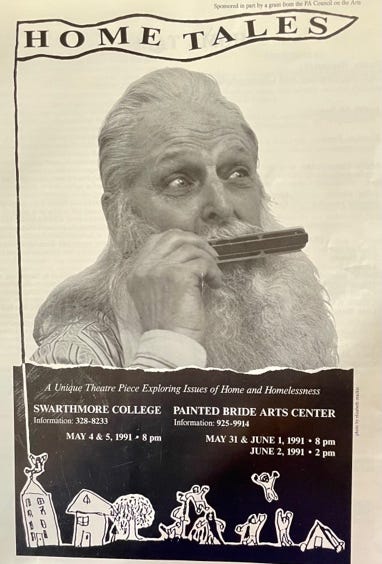
Paula interviewed dozens of people, both refugees and homeless people. I started to write that she was looking for the most compelling stories, but they were all compelling—Vietnamese refugees making a new home in a very foreign land, a family from El Salvador had been living in sanctuary in a church, a seventy-three year old man who had been living on the streets for the last seven years.
Paula selected people who wanted to tell their stories through this project and I began to write the play, sifting through an enormous amount of material, looking for themes, for a way to organize these experiences. I found the process humbling. People were playing themselves and when they told the various parts of stories sometimes they followed my script and sometimes they just spoke their memories and present realities in their own words. The play was performed five times and each time the script was slightly different. The exact words didn’t matter. What mattered was the person telling the story. What mattered was that the audience heard these stories and began the process of understanding, of standing with, of caring, of compassion.
I wrote song lyrics and composer Heath Allen wrote the music and Maya Newton sang the songs.
Does Anybody Care?
We stand in our own lives
defenseless.
It we don’t see the suffering
around us
maybe we can escape it,
maybe it won’t come to us.
Chorus: Does anybody care?
Does anybody see?
The words hang in the air.
I want them to break free...
Nearly forty years ago people did care enough to conceptualize this play, to create the performances, to sponsor the play in a college theater, to attend the live performances.
Today we read that compassion like this is suspect. A PBS headline in August, 2025, asked, Is empathy a sin? Some conservative Christians argue it can be.
Empathy is usually regarded as a virtue, a key to human decency and kindness. And yet, with increasing momentum, voices on the Christian right are preaching that it has become a vice.
For them, empathy is a cudgel for the left: It can manipulate caring people into accepting all manner of sins according to a conservative Christian perspective, including abortion access, LGBTQ+ rights, illegal immigration and certain views on social and racial justice.
“Empathy becomes toxic when it encourages you to affirm sin, validate lies or support destructive policies,” said Allie Beth Stuckey, author of “Toxic Empathy: How Progressives Exploit Christian Compassion.”
What affirms sin? Believing that gay people deserve human rights? Believing that refugees fleeing violence deserve safety and protection? Believing in equal rights for all regardless of race?
No. Empathy is not a “cudgel for the left.” Empathy is what makes us human. Empathy is the ability to care for others, even when the lives they lead may seem completely foreign, unnatural. I don’t have to approve of someone else’s choices. I do have to grant them the right to make those choices.
I am afraid that we are being directed to un-learn compassion. That is what happens when cruelty becomes the point. When cruelty and violence are affirmed as a way to intimidate refugees and immigrants. When compassion is not a virtue but a weakness.
I don’t want to live in a world where compassion is a sin. Do you?
Thank you for this, Judith. Recent science suggests that we're born with empathy or compassion because we're herd animals. But it seems that we can unlearn it, perhaps by coming in contact with severe or repeated mistreatment. What we are seeing in our country now is a call to offer compassion and empathy where it is needed and wanted. That way, we have a chance of creating a community in which we want to spend our lives.
Thanks, Judith. A lovely and important reflection.